

Company Apps and Scripts
Application Manager gives you three ways to deploy software to Windows endpoints: Company Apps, Scripts, and Repository Apps. Choosing the right type saves time and reduces maintenance overhead — understanding the differences is the first step.
The three app types
Section titled “The three app types”Company Apps
Section titled “Company Apps”Company Apps are installer files you upload yourself — MSI, EXE, or similar. Use them for in-house applications, licensed software that cannot be distributed through a public catalog, or any application that CapaOne does not already include in its Repository.
You control the version entirely. When a new release of the software is available, you upload the new installer and update the app entry manually. In CapaOne, a Company App has the type Custom Application. See Create a Company App.
Company Apps and Scripts share a storage quota per organization, shown as a Storage bar at the top of both tabs. The quota is 100 GB unless your contract says otherwise.
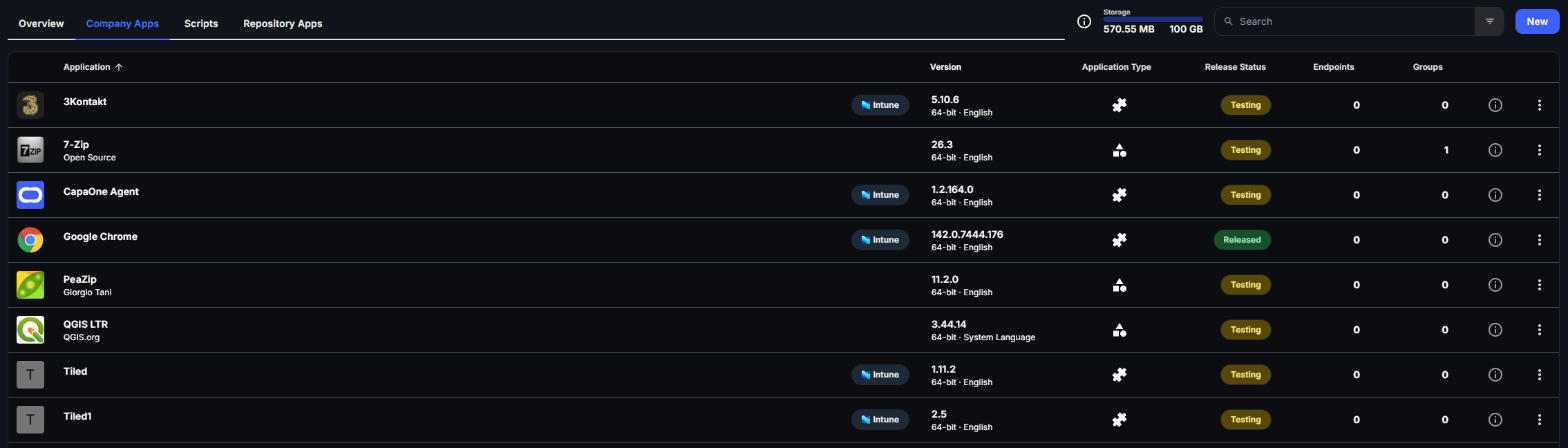
The Company Apps tab also lists the Repository Apps you’ve added, with the type Repository Application.
Scripts
Section titled “Scripts”Scripts run configuration tasks on assigned endpoints: one-off fixes, system checks, or anything that is not a traditional installer. You build a script from PowerBricks instead of writing code, and you can upload files that the script uses when it runs. Like Company Apps, scripts are versioned and go through the same release status workflow. See Create a Script.
Repository Apps
Section titled “Repository Apps”Repository Apps are a curated catalog of common applications maintained by CapaOne, with versions sourced automatically from winget. See Repository Apps for the full catalog behavior.
PowerBricks
Section titled “PowerBricks”PowerBricks are CapaSystems-maintained PowerShell building blocks that you can use in both Company Apps and Scripts. Each PowerBrick is a ready-made script component covering a common task — such as installing software silently, configuring Windows settings, or handling prerequisites — so you do not have to write everything from scratch.
Use PowerBricks to speed up script authoring and reduce errors. You can combine multiple PowerBricks into a single script or embed them in a Company App’s install logic.
Release status workflow
Section titled “Release status workflow”Company Apps, Scripts, and Repository Apps have a Release status:
- Testing — the default for new apps and scripts. When you assign an app in Testing, CapaOne asks you to confirm that you understand it hasn’t been thoroughly tested. Assign it to a few test endpoints to validate its behavior before rolling out broadly.
- Released — the app or script is ready for production deployment.
- Retired — the app or script can’t be assigned to groups or endpoints anymore.
Promote an app from Testing to Released once you have confirmed it installs and behaves correctly.
Monitor patch compliance
Section titled “Monitor patch compliance”The Overview tab under Windows → Applications gives a fleet-wide view of application patch status:
- Patch Percentage — the share of patches that are up to date, available, or in progress across all endpoints. A low percentage means many endpoints are running outdated software.
- Repository Apps Compliance — for the top five Repository Apps, the share of devices with the latest version installed.
- Patch Compliance History — available updates compared with patches installed per day over the last 30 days. Click a bar to see details.
- Repository Apps Updates Available, Repository Apps Up-to-Date, Repository Apps in Progress, and Repository Apps Failed — which apps are in each state, and on how many endpoints.
Use the filter bar on the tab to limit the widgets to a set of endpoints.
Use the Overview tab regularly to identify which apps need attention and to confirm that a recent deployment raised compliance as expected.
Assign apps to endpoints or groups
Section titled “Assign apps to endpoints or groups”Company Apps are assigned either to individual endpoints or to groups. Group assignment is the preferred approach for anything that should apply broadly — it means new devices that join the group automatically receive the software without additional steps.
Click the app name to open its detail page and manage group and endpoint assignments from there. See Assign and Redeploy Windows Applications.
Good to know
Section titled “Good to know”- Storage is shared between Company Apps and Scripts. If you are running low, delete the Company Apps and Scripts you no longer need, for example old versions. Repository Apps don’t use your storage.
- Clicking endpoint or group counts in the app list navigates directly to the assignment details for that app, making it easy to audit which devices have a specific application.
- Scripts can complement Company Apps — for example, a script can run pre- or post-installation checks alongside a Company App deployment using Automation workflows.
- Upload to Intune — a Company App can also be uploaded to Microsoft Intune. See Upload a Company App to Intune.
Related
Section titled “Related”- Repository Apps — CapaOne’s curated, self-updating app catalog
- Application Manager — overview of the deployment surfaces
- Installation Tiers — how installations are sequenced against each other
- Automation — run scripts around an app deployment